Personalization at Scale: Boost US Customer Engagement by 18% by 2026
In today’s hyper-competitive digital landscape, capturing and retaining customer attention is paramount for brand survival and growth. For US brands, the imperative to deliver exceptional, tailored experiences has never been stronger. The promise of customer engagement personalization is not just a buzzword; it’s a strategic imperative with tangible benefits. Projections indicate that by year-end 2026, US brands leveraging advanced personalization at scale can expect to see an impressive 18% higher customer engagement. This isn’t merely about addressing customers by their first name; it’s about understanding their unique needs, preferences, and behaviors to deliver relevant, timely, and impactful interactions across every touchpoint.
The journey towards achieving this ambitious goal requires a comprehensive understanding of what customer engagement personalization truly entails, the technologies that enable it, and the strategic frameworks necessary for successful implementation. This article will delve deep into the mechanics of personalization at scale, explore its profound impact on customer loyalty and satisfaction, and provide actionable insights for US brands aiming to lead the charge in this transformative era of marketing.
Understanding Personalization at Scale: More Than Just a Name
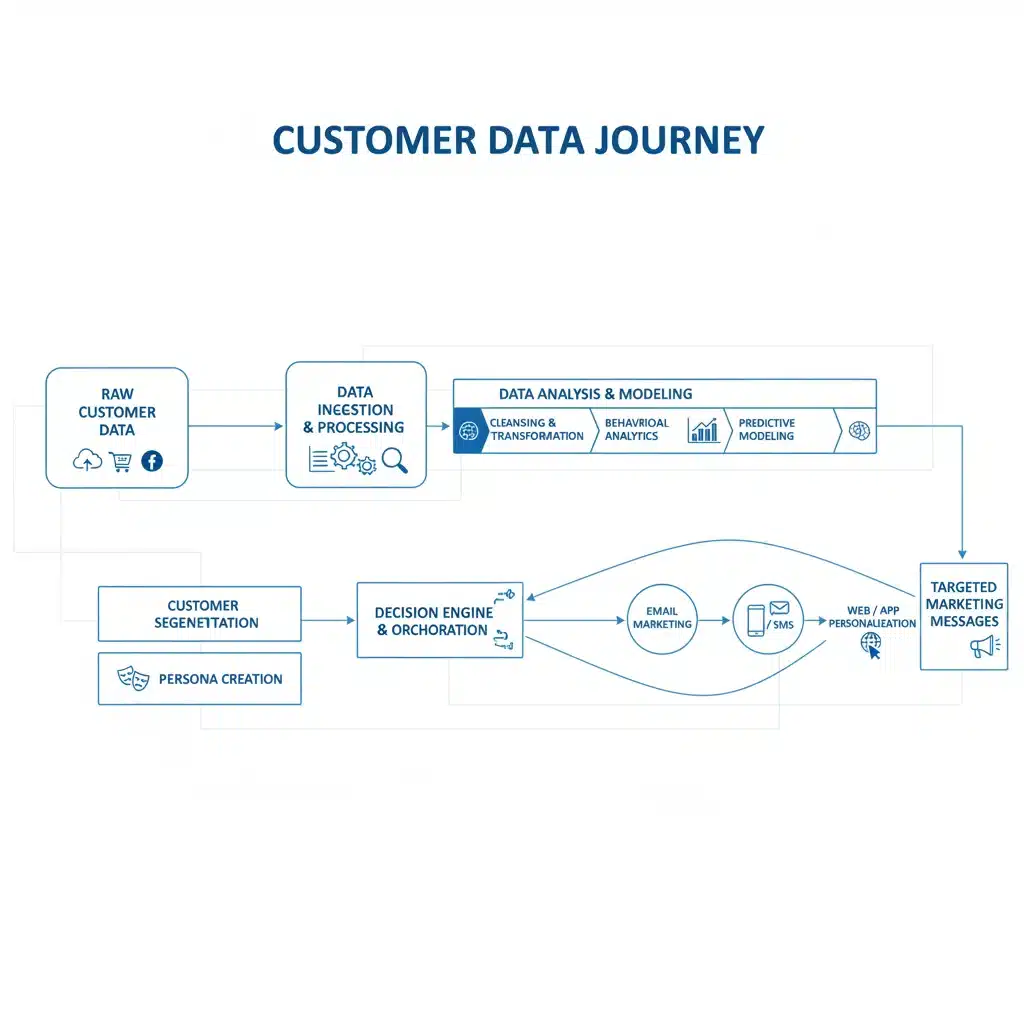
Personalization at scale transcends basic segmentation. It involves leveraging vast amounts of data – demographic, behavioral, transactional, and psychographic – to create highly individualized experiences for millions of customers simultaneously. This level of customization is achieved through sophisticated algorithms, machine learning, and artificial intelligence that can process and interpret data faster and more accurately than human analysis alone.
For US brands, the challenge lies not just in collecting data, but in effectively utilizing it to predict customer needs and proactively offer solutions or content that resonates deeply. This proactive approach is what drives significant increases in customer engagement personalization. Instead of waiting for customers to express a need, brands can anticipate it, creating a sense of being understood and valued.
Consider a retail brand that knows a customer frequently browses running shoes, has previously purchased a specific brand, and tends to shop on weekends. Personalization at scale would allow this brand to send a targeted email on a Friday afternoon, highlighting new arrivals from that preferred brand, perhaps even offering a discount on a related accessory like performance socks, based on past purchase patterns. This level of detail moves beyond simple recommendations to a truly bespoke shopping experience.
The Data Foundation: Fueling Personalized Experiences
At the heart of effective customer engagement personalization is robust data management. US brands must invest in platforms and processes that allow for the seamless collection, integration, and analysis of data from various sources. This includes:
- First-Party Data: Information collected directly from customer interactions, such as purchase history, website browsing behavior, email engagement, and app usage. This is the most valuable data as it is proprietary and highly relevant.
- Second-Party Data: Data shared directly from another company, often a partner. This can augment first-party data and provide a broader view of customer behavior.
- Third-Party Data: Data purchased from external sources, typically aggregated from various platforms. While useful for broader targeting, its relevance can be less precise than first-party data.
The ability to unify these diverse data sets into a single customer view is critical. Customer Data Platforms (CDPs) have emerged as essential tools for this purpose, breaking down data silos and enabling marketers to access a holistic understanding of each customer. Without a unified data strategy, personalization efforts will remain fragmented and less effective, hindering the potential for an 18% increase in customer engagement.
Key Technologies Driving Personalization at Scale
Achieving advanced customer engagement personalization relies heavily on cutting-edge technologies. US brands must strategically adopt and integrate these tools to build truly personalized customer journeys:
- Artificial Intelligence (AI) and Machine Learning (ML): These are the engines of personalization. AI algorithms can analyze vast datasets to identify patterns, predict future behaviors, and automate content recommendations. ML models continuously learn and refine their understanding of individual preferences, ensuring that personalization efforts become more accurate and effective over time.
- Customer Data Platforms (CDPs): As mentioned, CDPs consolidate customer data from all sources into a persistent, unified profile. This single source of truth empowers marketers to create highly segmented audiences and deliver consistent, personalized experiences across all channels.
- Marketing Automation Platforms (MAPs): These platforms automate repetitive marketing tasks, including email campaigns, social media posts, and ad targeting. When integrated with CDPs and AI, MAPs can trigger personalized communications based on real-time customer behavior, ensuring timely and relevant interactions.
- Content Management Systems (CMS) with Personalization Capabilities: Modern CMS platforms allow for dynamic content delivery, meaning different users can see different versions of a webpage or app content based on their profiles and behaviors. This ensures that every visit to a brand’s digital property is tailored to the individual.
- Recommendation Engines: Often powered by AI, these engines analyze past interactions and preferences to suggest products, services, or content that a customer is likely to be interested in. E-commerce giants like Amazon have perfected this, setting a high bar for customer engagement personalization.
Implementing these technologies requires not only financial investment but also a strategic roadmap and a skilled team capable of managing and optimizing them. Brands that commit to this technological evolution will be better positioned to achieve the projected engagement uplift.
Strategic Pillars for Enhanced Customer Engagement Personalization
Beyond technology, successful customer engagement personalization rests on several strategic pillars:
1. Hyper-Segmentation and Micro-Segmentation
While traditional segmentation divides customers into broad groups, hyper-segmentation and micro-segmentation delve deeper. This involves creating extremely granular segments based on specific behaviors, interests, and demographics. For example, instead of just ‘female shoppers,’ a brand might target ‘female shoppers aged 25-34 who have purchased athleisure wear in the last 3 months and frequently browse yoga accessories.’
This level of detail allows for highly relevant messaging, which directly contributes to higher engagement. The more precise the segment, the more personalized the message, and the greater the likelihood of a positive response. US brands should continuously refine their segmentation strategies using data-driven insights.
2. Omnichannel Consistency
Customers interact with brands across multiple channels – website, mobile app, email, social media, in-store, customer service. A truly personalized experience requires consistency across all these touchpoints. If a customer adds an item to their cart on a mobile app but abandons it, a personalized email reminder should acknowledge this action. If they then call customer service, the agent should have access to their recent interactions and preferences.
This seamless, unified experience builds trust and reinforces the feeling that the brand truly understands the customer. Disjointed experiences, conversely, can lead to frustration and decreased engagement, undermining efforts to boost customer engagement personalization.
3. Real-Time Personalization
The ability to personalize experiences in real time is a game-changer. This means adapting content, offers, and recommendations instantly based on a customer’s current behavior. For instance, if a user clicks on a specific product category on a website, real-time personalization would immediately adjust the displayed promotions, related products, and even on-site messaging to reflect that interest.
Real-time personalization leverages dynamic content delivery and AI-powered recommendation engines to ensure that every interaction is maximally relevant at the moment it occurs. This immediacy is crucial for capturing attention and driving conversions in a fast-paced digital environment, significantly impacting the 18% engagement goal.
4. Predictive Analytics
Moving beyond understanding past behavior, predictive analytics uses historical data to forecast future customer actions. This could include predicting churn risk, identifying customers likely to make a repeat purchase, or anticipating which products a customer might be interested in next. With this foresight, US brands can proactively engage customers with tailored interventions.
For example, if predictive analytics identifies a customer at high risk of churn, a brand could send a personalized re-engagement offer or a survey to understand their concerns. This proactive problem-solving is a powerful form of customer engagement personalization.
5. Ethical Data Usage and Transparency
While the drive for personalization is strong, brands must prioritize ethical data practices and transparency. Customers are increasingly concerned about their privacy. Brands that are transparent about how they collect and use data, and that offer customers control over their personal information, will build greater trust and loyalty. Compliance with regulations like CCPA is not just a legal requirement but a foundation for ethical customer relationships.
Trust is a critical component of engagement. Brands that misuse data or are opaque about their practices risk alienating customers, negating any potential gains from personalization efforts.

Measuring the Impact: Quantifying 18% Higher Engagement
To truly understand the value of customer engagement personalization, US brands must establish clear metrics and continuously measure their performance. The ‘18% higher customer engagement’ target isn’t arbitrary; it’s a measurable outcome that can be tracked through various KPIs:
- Conversion Rates: Personalized experiences often lead to higher conversion rates, whether it’s a purchase, a sign-up, or a download.
- Click-Through Rates (CTR): Personalized emails, ads, and recommendations typically see higher CTRs compared to generic content.
- Time Spent on Site/App: When content is highly relevant, customers spend more time engaging with it.
- Repeat Purchase Rate/Customer Lifetime Value (CLTV): Personalization fosters loyalty, leading to more repeat business and increased CLTV.
- Reduced Churn Rate: Proactive personalization can identify and address customer dissatisfaction, reducing the rate at which customers leave.
- Customer Satisfaction (CSAT) and Net Promoter Score (NPS): A positive and personalized experience directly contributes to higher satisfaction and willingness to recommend the brand.
By diligently tracking these metrics, US brands can quantify the impact of their personalization initiatives and demonstrate a clear return on investment. This data-driven approach allows for continuous optimization and refinement of personalization strategies, ensuring sustained growth in customer engagement.
Challenges and How to Overcome Them
Implementing personalization at scale is not without its challenges. US brands may encounter:
- Data Silos: Data residing in disparate systems makes it difficult to create a unified customer view. Overcome this with CDPs and robust data integration strategies.
- Lack of Skilled Talent: The need for data scientists, AI specialists, and personalization strategists is growing. Invest in training existing staff or recruit specialized talent.
- Technological Complexity: Integrating multiple platforms can be complex. Opt for solutions that offer strong API capabilities and consider phased implementation.
- Maintaining Privacy and Trust: As discussed, prioritize ethical data usage, transparency, and compliance with privacy regulations.
- Content Creation at Scale: Producing personalized content for numerous segments can be resource-intensive. Leverage AI-powered content generation tools and dynamic content templates.
Addressing these challenges proactively is essential for US brands to successfully navigate the complexities of personalization at scale and realize the significant benefits of enhanced customer engagement personalization.
The Future is Personal: A Call to Action for US Brands
The projection of 18% higher customer engagement for US brands by year-end 2026 through personalization at scale is not a distant dream but an achievable reality for those willing to embrace the future of marketing. The shift from mass marketing to hyper-individualized experiences is not just a trend; it’s a fundamental evolution in how brands connect with their customers.
Brands that prioritize data unification, leverage advanced AI and ML technologies, and build strategic frameworks around hyper-segmentation, omnichannel consistency, and real-time personalization will be the ones that thrive. They will not only capture a larger share of customer attention but also cultivate deeper loyalty, advocacy, and ultimately, greater profitability.
For US brands, the time to act is now. Investing in robust data infrastructure, adopting intelligent personalization platforms, and fostering a culture of customer-centricity are no longer optional but essential steps towards securing a competitive edge. The journey to 18% higher customer engagement is a strategic marathon, but with the right tools and approach, the finish line is well within reach, promising a future where every customer interaction is meaningful, relevant, and deeply personal.