RPA’s Impact: Redefining 1 Million U.S. Jobs by 2027

The Future of Work: How Robotic Process Automation (RPA) Will Redefine 1 Million U.S. Jobs by 2027
The landscape of employment is in a constant state of flux, driven by technological advancements that continually reshape how we work. Among these innovations, Robotic Process Automation (RPA) stands out as a particularly disruptive, yet transformative, force. Projections suggest that by 2027, RPA will play a pivotal role in redefining a staggering 1 million U.S. jobs. This isn’t just about job displacement; it’s about a fundamental shift in job roles, skill requirements, and the very nature of human-computer interaction in the workplace. Understanding this impending transformation is crucial for businesses, employees, and policymakers alike to navigate the future of work successfully.
At its core, RPA involves the use of software robots, or ‘bots,’ to automate repetitive, rule-based tasks typically performed by humans. These bots can interact with applications, process transactions, manipulate data, and communicate with other digital systems. Unlike traditional IT automation, RPA doesn’t require complex coding or system integrations; it mimics human actions within existing applications, making it accessible and deployable across various industries. From finance and healthcare to manufacturing and customer service, the potential for RPA to streamline operations, reduce errors, and enhance efficiency is immense.
However, the narrative surrounding RPA is often polarized. On one hand, it’s hailed as a productivity booster, freeing human workers from mundane tasks to focus on more strategic, creative, and value-added activities. On the other, it raises concerns about job losses and the obsolescence of certain skill sets. The reality, as this article will explore, lies somewhere in between. The impact of RPA on jobs is less about outright elimination and more about redefinition, requiring a proactive approach to re-skilling and up-skilling the workforce.
This comprehensive exploration will delve into the mechanisms of RPA, its current adoption trends, and the specific ways it is expected to influence the U.S. job market by 2027. We will examine the types of jobs most susceptible to automation, the emerging roles that RPA will create, and the critical skills needed to thrive in this evolving environment. Furthermore, we will discuss the strategic implications for businesses seeking to implement RPA and the societal responsibilities in preparing the workforce for this significant change. The goal is to provide a balanced perspective on how RPA jobs future will unfold, offering insights and actionable strategies for adaptation.
Understanding Robotic Process Automation (RPA)
To grasp the profound impact of RPA, it’s essential to first understand what it is and how it functions. RPA is a technology that allows anyone to configure computer software, or a ‘robot,’ to emulate and integrate the actions of a human interacting within digital systems to execute a business process. RPA robots utilize the user interface to capture data and manipulate applications just like humans do. They can interpret, trigger responses, and communicate with other systems.
What Exactly is RPA?
Think of an RPA bot as a digital employee that never sleeps, makes mistakes, or asks for a raise. These bots are programmed to perform tasks such as:
- Opening emails and attachments
- Logging into applications
- Moving files and folders
- Extracting structured and semi-structured data from documents
- Filling in forms
- Copying and pasting data
- Making calculations
- Connecting to system APIs
- Reading and writing to databases
The key differentiator for RPA is its non-invasive nature. It doesn’t require changes to existing IT infrastructure. Instead, it operates at the presentation layer, interacting with applications through their user interfaces, just as a human would. This ease of implementation makes RPA an attractive solution for organizations looking to quickly automate processes without significant overhauls of their legacy systems.
RPA vs. Traditional Automation
While often used interchangeably, RPA differs from traditional IT automation in several crucial ways:
- Interface Interaction: RPA works at the UI level, mimicking human interaction. Traditional automation often involves backend integrations and API calls.
- Complexity: RPA is designed for simpler, rule-based, repetitive tasks. Traditional automation can handle more complex, logic-driven processes.
- Deployment: RPA tools are typically low-code or no-code, allowing business users to configure bots. Traditional automation often requires specialized programming skills.
- Cost and Speed: RPA generally offers faster deployment and a quicker return on investment for specific tasks compared to large-scale traditional automation projects.
This distinction is vital when considering the impact on jobs. RPA is not automating entire complex systems but rather specific, repeatable human actions within those systems. This means that while certain tasks are automated, the broader strategic and analytical components of a job often remain, or even expand, for human workers.
The Current State of RPA Adoption and Growth
The adoption of RPA has been accelerating rapidly across industries. Organizations are increasingly recognizing its potential to drive efficiency, improve accuracy, and reduce operational costs. This widespread acceptance is a significant factor in its projected impact on the U.S. job market by 2027.
Key Drivers of RPA Growth
- Cost Reduction: Automating repetitive tasks significantly lowers operational expenditures.
- Improved Accuracy: Bots eliminate human error, leading to higher quality and compliance.
- Increased Efficiency: Bots can operate 24/7, processing tasks much faster than humans.
- Scalability: RPA solutions can be easily scaled up or down to meet fluctuating demands.
- Enhanced Customer Experience: Faster processing and fewer errors lead to better service.
- Focus on Value-Added Work: Freeing human employees from mundane tasks allows them to concentrate on strategic initiatives.
According to various industry reports, the global RPA market is experiencing double-digit growth, with projections indicating it will continue to expand significantly in the coming years. This growth is not confined to large enterprises; small and medium-sized businesses are also beginning to explore and implement RPA solutions to remain competitive.
Industries leading the charge in RPA adoption include financial services, healthcare, insurance, and telecommunications, sectors characterized by high volumes of transactional data and rule-based processes. However, its application is broadening, with manufacturing, retail, and government agencies also finding innovative uses for RPA. This widespread and growing adoption underpins the estimates of its profound influence on RPA jobs future.
Redefining 1 Million U.S. Jobs by 2027: The Core Impact
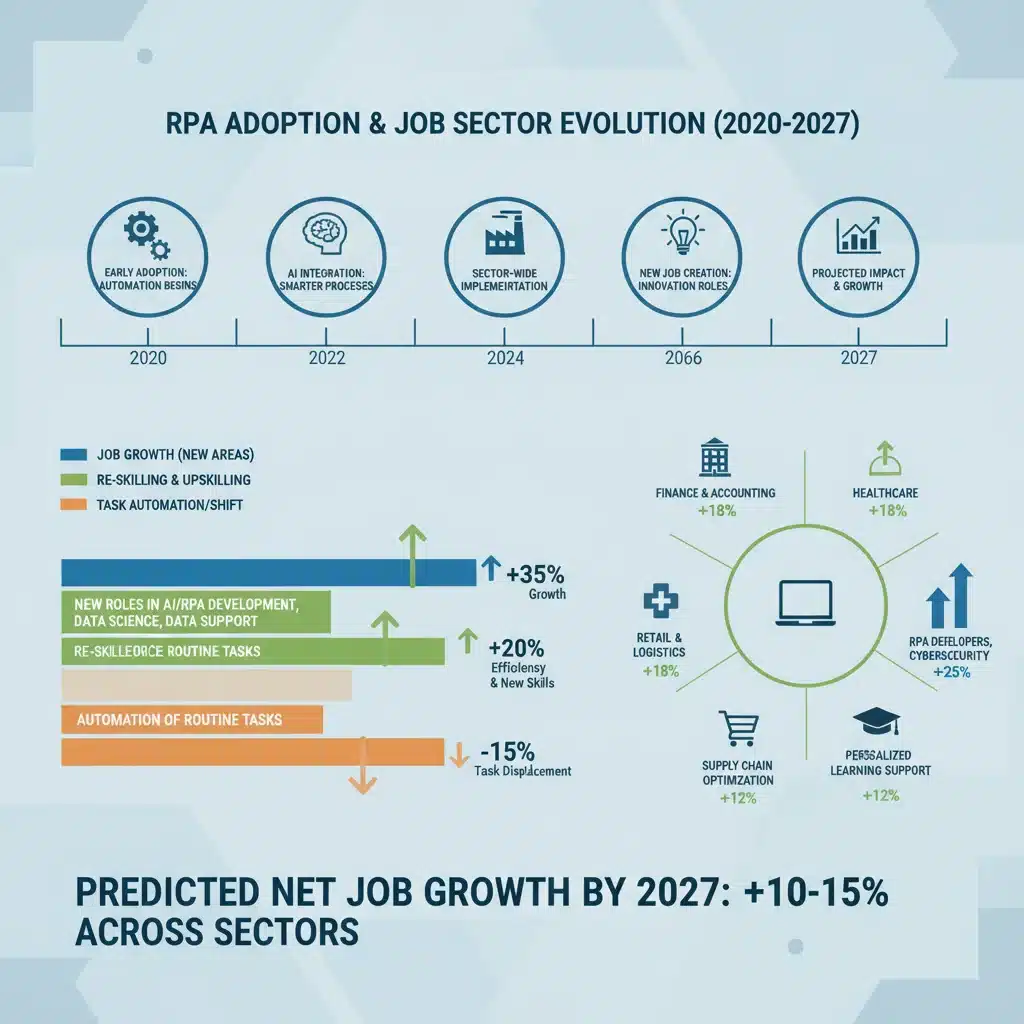
The headline figure of 1 million U.S. jobs being redefined by 2027 might sound alarming, but it’s crucial to understand the nuance behind ‘redefined’ rather than simply ‘eliminated.’ This redefinition encompasses several facets:
1. Automation of Repetitive Tasks
Many jobs, particularly those involving data entry, claims processing, customer service inquiries, and back-office operations, consist of a significant portion of highly repetitive, rule-based tasks. These are prime candidates for RPA. When these tasks are automated, the human role associated with them doesn’t necessarily disappear but shifts.
For example, a data entry clerk whose primary function was transcribing information might find that RPA bots now handle 80% of that work. Their job is then redefined to focus on the remaining 20% of complex cases, data validation, exception handling, or even training and monitoring the bots themselves. This shift requires a different set of skills and a higher level of cognitive engagement.
2. Creation of New Roles
The implementation and management of RPA solutions themselves create new job categories. These include:
- RPA Developers: Professionals who design, build, and configure RPA bots.
- RPA Business Analysts: Individuals who identify automation opportunities, analyze processes, and define requirements for RPA solutions.
- RPA Architects: Experts who design the overall RPA infrastructure and strategy within an organization.
- RPA Support and Maintenance Specialists: Roles focused on monitoring, troubleshooting, and maintaining RPA deployments.
- Bot Trainers/Supervisors: Human roles responsible for overseeing bot performance, handling exceptions, and ensuring compliance.
These new roles often require a blend of technical acumen, process understanding, and problem-solving skills. The growth in these areas will partially offset the redefinition of existing roles, contributing to the overall transformation of the RPA jobs future.
3. Augmentation of Human Capabilities
In many instances, RPA doesn’t replace human workers but rather augments their capabilities, making them more efficient and effective. Consider a customer service representative. Instead of spending valuable time searching multiple systems for customer information, an RPA bot can instantly retrieve and present all relevant data, allowing the representative to focus on empathetic communication and complex problem-solving. This enhances job satisfaction and customer experience.
Similarly, in fields like accounting or legal services, RPA can automate the tedious collection and organization of data, enabling professionals to dedicate more time to analysis, strategic advice, and client interaction – activities that leverage uniquely human cognitive abilities.
4. Evolution of Existing Roles
Beyond the creation of entirely new roles, many existing job functions will evolve. Employees in roles impacted by RPA will need to adapt by acquiring new skills. For instance, an operations manager might transition from overseeing a team of manual processors to managing a hybrid workforce of humans and bots, requiring skills in automation governance, performance analytics, and change management.
The redefinition is not a sudden event but a gradual transformation, demanding continuous learning and adaptability from the workforce. The emphasis will shift from performing routine tasks to managing technology, analyzing outputs, and innovating.
Jobs Most Affected and Emerging Opportunities
While RPA’s reach is broad, certain job categories are more susceptible to automation, while others are poised for growth or significant transformation. Understanding these trends is key to preparing for the RPA jobs future.
Roles Most Susceptible to Automation
Jobs characterized by high volumes of repetitive, rule-based tasks are the primary targets for RPA. These often include:
- Data Entry Clerks: Tasks like inputting information from documents into systems.
- Accounts Payable/Receivable Clerks: Processing invoices, managing payments, and reconciliation.
- Customer Service Representatives (for routine queries): Handling frequently asked questions, order status checks, and basic support.
- Administrative Assistants (for routine tasks): Scheduling, data organization, and report generation.
- Loan Processors: Gathering and verifying documentation, credit checks.
- Insurance Claims Processors: Initial claim intake, data validation.
It’s important to reiterate that even in these roles, complete elimination is less common than task automation. The human element often remains for exception handling, complex problem-solving, and interpersonal communication.

Emerging and Growing Job Opportunities
As RPA automates the mundane, it simultaneously creates demand for roles that leverage uniquely human capabilities and those that manage the automation itself. These include:
- Automation Specialists/Engineers: Designing, implementing, and optimizing automation solutions.
- Data Scientists and Analysts: Interpreting the vast amounts of data generated by automated processes to derive insights and drive strategic decisions.
- AI/ML Engineers: Integrating more advanced artificial intelligence and machine learning capabilities with RPA for intelligent automation.
- Process Improvement Consultants: Experts who can analyze business processes and identify areas ripe for automation and optimization.
- Change Management Professionals: Guiding organizations and employees through the transition to an automated environment.
- Digital Ethics and Governance Specialists: Ensuring that automation is implemented responsibly and ethically.
- Creative and Innovation Roles: As routine tasks are offloaded, there’s a greater need for human creativity, strategic thinking, and problem-solving.
The shift implies a move towards jobs that require higher-order cognitive skills, emotional intelligence, and interpersonal communication, qualities that are difficult for current RPA technologies to replicate.
Skills for the Future: Adapting to the RPA Revolution
Given the redefinition of 1 million U.S. jobs, the most critical question for individuals and organizations is: What skills will be necessary to thrive in this new environment? The focus shifts from task-specific competencies to broader capabilities that complement automation.
Technical Skills
- RPA Tools Proficiency: Familiarity with leading RPA platforms (e.g., UiPath, Automation Anywhere, Blue Prism) will be valuable for those directly involved in automation development and management.
- Data Literacy: The ability to understand, interpret, and work with data will be crucial as more data is generated and analyzed by automated systems.
- Basic Programming/Scripting: Even for non-developers, a foundational understanding of programming logic can aid in understanding and interacting with automated systems.
- Cloud Computing Knowledge: As RPA solutions increasingly leverage cloud infrastructure, understanding cloud environments will be beneficial.
Soft Skills (Human-Centric Skills)
These are the skills that RPA struggles to replicate and will become even more valuable:
- Critical Thinking and Problem-Solving: Analyzing complex situations, identifying root causes, and devising innovative solutions.
- Creativity and Innovation: Generating new ideas, approaches, and solutions that go beyond rule-based execution.
- Emotional Intelligence: Understanding and managing one’s own emotions, and perceiving and influencing the emotions of others, essential for leadership, teamwork, and customer interaction.
- Adaptability and Flexibility: The ability to learn new technologies, adapt to changing work processes, and embrace continuous learning.
- Collaboration and Teamwork: Working effectively with diverse teams, including human-bot collaboration.
- Communication: Articulating complex ideas clearly, actively listening, and influencing others.
- Digital Literacy: A general comfort and proficiency with digital tools and platforms, extending beyond specific applications.
Investing in re-skilling and up-skilling programs that focus on these technical and soft skills will be paramount for individuals and organizations looking to navigate the challenges and capitalize on the opportunities presented by the RPA jobs future.
Strategic Implications for Businesses and Workforce Development
For businesses, the integration of RPA is not merely a technological upgrade; it’s a strategic imperative that requires careful planning and a holistic approach to change management. For workforce development, it necessitates a fundamental rethinking of education and training.
Business Strategies for RPA Implementation
- Start Small, Think Big: Begin with pilot projects to demonstrate value and build internal expertise before scaling across the organization.
- Focus on Process Optimization First: Automate broken processes at your peril. Streamline and optimize processes before applying RPA.
- Employee Engagement and Communication: Proactively communicate the benefits of RPA to employees, emphasizing augmentation rather than displacement. Involve them in identifying automation opportunities.
- Invest in Training and Re-skilling: Provide opportunities for employees to acquire new skills relevant to the automated workplace, including RPA development, data analytics, and advanced problem-solving.
- Establish a Center of Excellence (CoE): Create a dedicated team to govern RPA initiatives, share best practices, and drive adoption.
- Measure ROI Beyond Cost Savings: While cost reduction is a benefit, also track improvements in accuracy, compliance, employee satisfaction, and customer experience.
Companies that strategically implement RPA, focusing on human-in-the-loop automation and workforce empowerment, will be better positioned to harness its full potential and achieve sustainable growth in the evolving RPA jobs future.
Workforce Development and Education
The redefinition of 1 million U.S. jobs by 2027 calls for a concerted effort from educational institutions, government bodies, and private sector training providers:
- Curriculum Modernization: Educational programs must evolve to include digital literacy, data science fundamentals, critical thinking, and problem-solving from an early age.
- Lifelong Learning Initiatives: Governments and employers should collaborate to fund and promote continuous learning programs that allow workers to adapt to new technologies throughout their careers.
- Vocational Training for New Tech Roles: Develop specialized vocational courses for roles like RPA developers, bot supervisors, and automation analysts.
- Public-Private Partnerships: Foster collaboration between industry and academia to ensure that education and training align with the needs of the future job market.
- Focus on Human-Centric Skills: Emphasize the development of soft skills that are uniquely human and less susceptible to automation.
The goal is not just to prepare a new generation of workers but also to equip the existing workforce with the tools and knowledge necessary to thrive alongside automation. This proactive approach will mitigate potential negative impacts and ensure a smoother transition into the new RPA jobs future.
Challenges and Ethical Considerations
While the benefits of RPA are clear, its widespread adoption also brings forth several challenges and ethical considerations that need to be addressed thoughtfully.
Challenges in RPA Adoption
- Resistance to Change: Employees may fear job displacement, leading to resistance to new technologies.
- Process Complexity: Not all processes are suitable for RPA; highly complex or unstructured tasks remain challenging.
- Data Security and Governance: Ensuring that bots handle sensitive data securely and comply with regulations is paramount.
- Scalability Issues: Without proper planning, scaling RPA across an enterprise can become complex and costly.
- Lack of Skilled Talent: A shortage of professionals skilled in RPA development and management can hinder implementation.
- Maintaining Human Touch: In customer-facing roles, over-automation can lead to a depersonalized experience.
Ethical Considerations
The ethical implications of RPA, especially when combined with AI, are profound:
- Job Displacement vs. Redefinition: The ongoing debate about whether automation leads to net job loss or creation requires careful monitoring and proactive policy responses.
- Algorithmic Bias: If RPA systems are fed biased data, they can perpetuate and even amplify existing societal biases.
- Transparency and Explainability: Understanding how bots make decisions, especially in critical processes, is crucial for accountability.
- Digital Divide: Ensuring equitable access to education and re-skilling opportunities to prevent a widening gap between those who can adapt and those who cannot.
- Human Oversight: Establishing clear lines of responsibility and oversight for automated processes to prevent unintended consequences.
Addressing these challenges and ethical dilemmas requires a multi-stakeholder approach involving businesses, governments, educational institutions, and civil society. Ignoring them could undermine the potential benefits of RPA and exacerbate social inequalities, impacting the overall positive outlook for the RPA jobs future.
Conclusion: Navigating the RPA-Driven Future
The projection that Robotic Process Automation will redefine 1 million U.S. jobs by 2027 is not a harbinger of doom but a call to action. It signifies a profound, irreversible shift in the nature of work, where the emphasis moves from routine, repetitive tasks to those requiring higher-order cognitive functions, creativity, emotional intelligence, and strategic thinking. The RPA jobs future is one of augmentation, collaboration, and continuous evolution.
For individuals, this means embracing lifelong learning, proactively acquiring new technical skills related to automation and data, and honing uniquely human soft skills. The ability to adapt, solve complex problems, and collaborate effectively will be the hallmarks of success in the automated workplace.
For businesses, the journey involves more than just implementing RPA technology. It requires a strategic vision that places people at the center of digital transformation. Investing in employee training, fostering a culture of innovation, and designing processes that optimize human-robot collaboration will be critical for realizing the full potential of RPA.
For policymakers and educational institutions, the challenge lies in creating supportive ecosystems that facilitate this transition. This includes modernizing curricula, supporting re-skilling initiatives, and establishing ethical guidelines for automation. By working together, we can ensure that the benefits of RPA are widely distributed, leading to a more productive, efficient, and ultimately more human-centric future of work.
The future is not about robots replacing humans entirely; it’s about robots empowering humans to achieve more. As we move towards 2027, the redefinition of 1 million jobs by RPA will serve as a testament to our capacity for adaptation, innovation, and the continuous pursuit of progress in the evolving world of work.