Securing Your Digital Footprint: 7 Advanced Cybersecurity Measures US Businesses Must Implement by Q3 2026

In an increasingly interconnected world, the digital footprint of US businesses is expanding at an unprecedented rate. While this expansion brings immense opportunities, it also ushers in a new era of sophisticated cyber threats. From state-sponsored attacks to highly organized criminal enterprises, the adversaries are becoming more adept, and their methods more insidious. The cost of a data breach is not just financial; it encompasses reputational damage, loss of customer trust, and potential regulatory penalties. As such, cybersecurity is no longer an IT department’s sole responsibility but a critical business imperative that demands proactive and advanced strategies.
The landscape of cyber warfare is dynamic, with new vulnerabilities and attack vectors emerging constantly. Traditional perimeter-based defenses are proving insufficient against modern, polymorphic threats that can bypass conventional security measures. This necessitates a shift towards more resilient, adaptive, and predictive cybersecurity frameworks. US businesses, irrespective of their size or industry, must recognize this evolving threat landscape and fortify their defenses with advanced cybersecurity measures. The deadline for implementing these crucial updates is fast approaching: Q3 2026. This article delves into seven such advanced cybersecurity measures that are paramount for safeguarding your organization’s digital assets and ensuring business continuity.
The Imperative for Advanced Cybersecurity Measures
The statistics paint a grim picture. According to various industry reports, cyberattacks against US businesses have surged in recent years, with ransomware attacks becoming more frequent and disruptive. The average cost of a data breach continues to climb, and small to medium-sized businesses (SMBs) are often targeted due to perceived weaker defenses. Moreover, regulatory bodies are imposing stricter data protection laws, making compliance a significant concern for all enterprises. Failure to adopt robust advanced cybersecurity measures can lead to severe financial repercussions, legal liabilities, and a significant blow to brand reputation. Therefore, understanding and implementing these measures is not merely a recommendation; it’s a necessity for survival in the digital age.
The move towards cloud computing, remote workforces, and the Internet of Things (IoT) has further complicated the security perimeter, making it more porous and challenging to defend. This distributed environment requires a holistic and adaptive approach to security, moving beyond static defenses to dynamic, intelligence-driven strategies. The advanced cybersecurity measures discussed here are designed to address these modern challenges, offering a multi-layered defense that is resilient to even the most sophisticated attacks. By Q3 2026, businesses should aim to have these strategies not just in place, but deeply integrated into their operational fabric, fostering a culture of security from the top down.
1. Implementing Zero-Trust Architecture (ZTA)
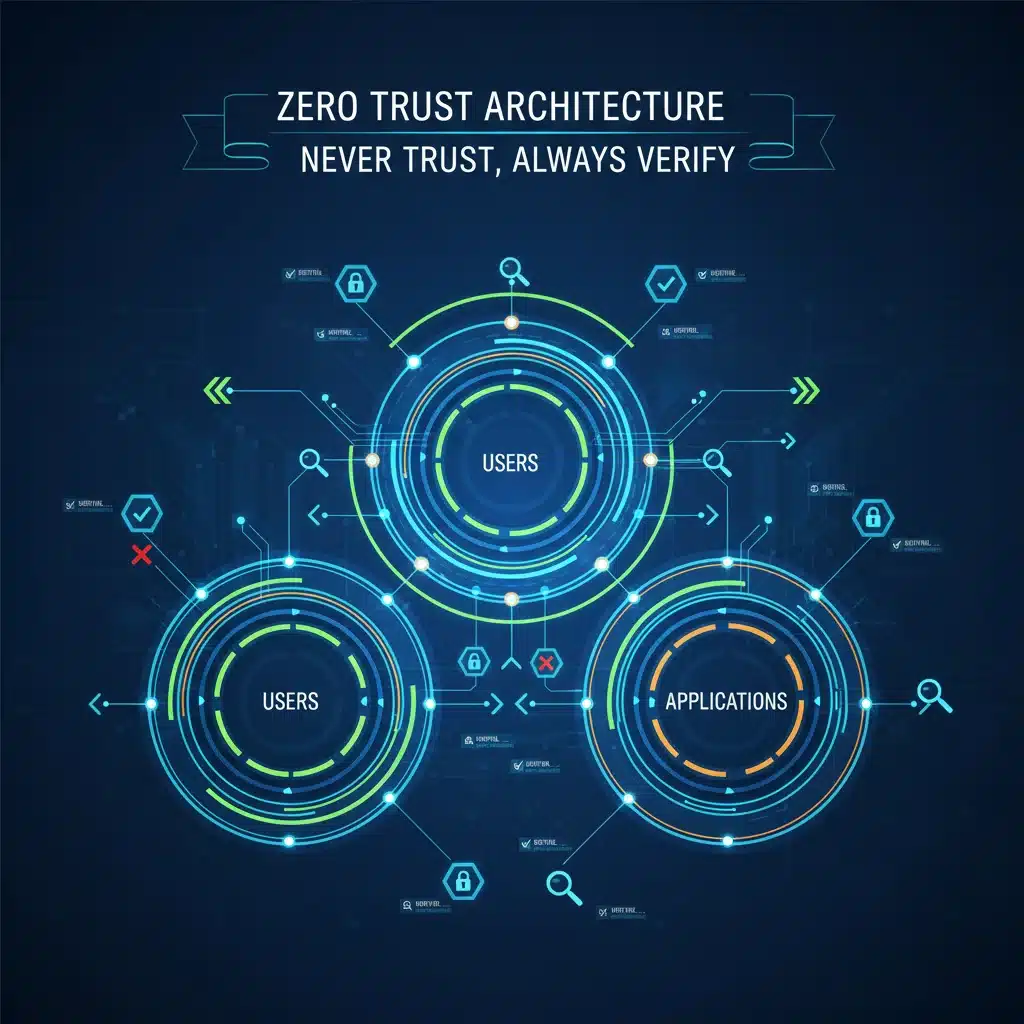
Traditional security models operate on the premise that everything inside an organization’s network perimeter is inherently trustworthy. This ‘trust but verify’ approach is fundamentally flawed in today’s threat landscape. A single compromised credential or device inside the network can lead to widespread breaches. Zero-Trust Architecture (ZTA) completely upends this model, operating on the principle of ‘never trust, always verify’. Every user, device, and application attempting to access resources, whether inside or outside the network, must be authenticated and authorized.
ZTA involves micro-segmentation, where network segments are broken down into smaller, isolated zones, and access to each zone requires explicit authorization. It also emphasizes strong identity verification, multi-factor authentication (MFA) for all access points, and continuous monitoring of user and device behavior. By treating every access request as potentially malicious, ZTA significantly reduces the attack surface and limits the lateral movement of attackers within a compromised network. For US businesses, adopting ZTA by Q3 2026 is critical for mitigating the risks associated with insider threats and sophisticated external attacks that manage to breach initial defenses.
Implementing ZTA is a journey, not a destination. It requires a comprehensive understanding of an organization’s assets, data flows, and user access patterns. The process typically involves identifying protected surfaces (data, applications, assets, services), mapping transaction flows, building a zero-trust policy, and continuously monitoring and improving the architecture. This advanced cybersecurity measure is foundational for building a resilient security posture in the modern era.
2. Advanced Threat Intelligence and Proactive Threat Hunting
Reactive security measures are no longer sufficient. Businesses need to shift towards a proactive stance, anticipating and neutralizing threats before they can cause damage. This is where advanced threat intelligence (ATI) and proactive threat hunting come into play. ATI involves gathering, processing, and analyzing information about emerging threats, attack methodologies, and adversary tactics, techniques, and procedures (TTPs) from various sources – open source, commercial feeds, and internal telemetry.
This intelligence then informs proactive threat hunting, which is the practice of actively searching for unknown threats or vulnerabilities within an organization’s network that have evaded existing security solutions. Unlike traditional security operations that respond to alerts, threat hunting assumes that a breach has likely already occurred or is imminent. It leverages human expertise, analytics, and threat intelligence to identify subtle indicators of compromise (IOCs) or anomalous behaviors that might signify an ongoing attack.
For US businesses, integrating ATI into their security operations center (SOC) and establishing a dedicated threat hunting team or capability by Q3 2026 will significantly enhance their ability to detect and respond to sophisticated, stealthy attacks. This advanced cybersecurity measure allows organizations to stay one step ahead of cybercriminals, reducing dwell time and minimizing the impact of potential breaches. It requires skilled personnel, advanced analytical tools, and a continuous feedback loop between intelligence gathering and hunting activities.

3. Enhanced Cloud Security Posture Management (CSPM)
The widespread adoption of cloud services introduces new security challenges. Misconfigurations in cloud environments are a leading cause of data breaches. Cloud Security Posture Management (CSPM) tools are designed to identify and remediate these misconfigurations, ensuring continuous compliance with security policies and regulatory requirements across multi-cloud and hybrid cloud environments.
Enhanced CSPM goes beyond basic configuration checks. It provides continuous monitoring of cloud resources, identifies vulnerabilities, detects suspicious activities, and offers automated remediation capabilities. It helps businesses understand their cloud attack surface, manage identities and access in the cloud, and ensure data protection in cloud storage. As US businesses increasingly rely on cloud infrastructure for critical operations and data storage, establishing a robust CSPM strategy by Q3 2026 is non-negotiable.
This advanced cybersecurity measure ensures that cloud environments are consistently configured according to best practices and compliance standards, preventing common attack vectors exploited by cybercriminals. It also provides visibility into shadow IT and unmanaged cloud resources, bringing them under the security umbrella. Investing in comprehensive CSPM solutions and integrating them with existing security operations is crucial for maintaining a secure cloud footprint.
4. AI/ML-Powered Security Analytics and Automation
The sheer volume of security data generated by modern IT environments makes manual analysis impossible. Artificial Intelligence (AI) and Machine Learning (ML) are transforming cybersecurity by enabling faster, more accurate detection and response to threats. AI/ML-powered security analytics can process vast datasets to identify patterns, anomalies, and sophisticated attack indicators that would be missed by traditional rule-based systems.
These advanced cybersecurity measures leverage algorithms to learn from past incidents, predict future threats, and automate routine security tasks. This includes automated threat detection, anomaly detection, user and entity behavior analytics (UEBA), and security orchestration, automation, and response (SOAR). By automating repetitive tasks, security teams can focus on more complex strategic issues, improving efficiency and reducing response times.
US businesses must integrate AI/ML into their security operations by Q3 2026 to keep pace with the evolving threat landscape. This means adopting security information and event management (SIEM) systems with advanced analytics capabilities, implementing UEBA solutions to detect compromised accounts, and exploring SOAR platforms to streamline incident response. The goal is to move towards a more intelligent, self-defending security infrastructure that can adapt and respond autonomously to emerging threats.
5. Advanced Endpoint Detection and Response (EDR) with XDR Integration
Endpoints – laptops, desktops, servers, mobile devices – remain primary targets for cyberattacks. Traditional antivirus solutions are often insufficient against fileless malware, zero-day exploits, and advanced persistent threats (APTs). Advanced Endpoint Detection and Response (EDR) solutions provide continuous monitoring and collection of endpoint data, enabling real-time detection, investigation, and response to sophisticated threats.
EDR goes beyond simply blocking known threats; it focuses on detecting malicious activities and behaviors that indicate an attack in progress. Extended Detection and Response (XDR) takes this a step further by integrating security data from multiple sources – endpoints, network, cloud, email, identity – into a unified platform. This provides a much broader and deeper view of potential threats across the entire IT ecosystem, enabling more effective threat correlation and faster incident response.
For US businesses, deploying advanced EDR solutions and actively working towards XDR integration by Q3 2026 is vital. This advanced cybersecurity measure offers superior visibility into endpoint activities, facilitates rapid containment of threats, and provides comprehensive forensic capabilities for post-incident analysis. It’s about moving from isolated security tools to a cohesive, integrated security fabric that can detect and respond to threats across all domains.
6. Robust Data Encryption and Data Loss Prevention (DLP)
Data is the lifeblood of any modern business, and its protection is paramount. Robust data encryption, both in transit and at rest, is a fundamental advanced cybersecurity measure. This ensures that even if data is intercepted or stolen, it remains unintelligible and unusable to unauthorized parties. Encryption should be applied to sensitive data across all storage locations, including databases, cloud storage, and endpoint devices.
Alongside encryption, Data Loss Prevention (DLP) solutions are essential for preventing sensitive information from leaving the organization’s control. DLP systems identify, monitor, and protect confidential data whether it’s stored, in use, or in transit. They can prevent accidental or malicious sharing of sensitive data through email, cloud applications, removable media, or other channels.
By Q3 2026, US businesses must implement comprehensive encryption strategies and deploy intelligent DLP solutions that are tailored to their specific data types and regulatory requirements. This advanced cybersecurity measure helps in achieving compliance with regulations like HIPAA, GDPR, and CCPA, and significantly reduces the risk of costly data breaches. A well-implemented DLP strategy requires continuous tuning and adaptation to evolving business processes and data flows.
7. Regular Security Audits, Penetration Testing, and Employee Training
Technology alone is not enough; a strong security posture requires continuous assessment and a human element. Regular security audits and penetration testing are critical advanced cybersecurity measures for identifying vulnerabilities before attackers can exploit them. Security audits review an organization’s security policies, controls, and configurations, while penetration testing simulates real-world attacks to uncover exploitable weaknesses in systems, applications, and networks.
These assessments should be conducted by independent third parties to ensure objectivity and thoroughness. The findings from these audits and tests should then be used to prioritize and remediate identified vulnerabilities, strengthening the overall security posture. This continuous cycle of assessment and improvement is vital for adapting to new threats and maintaining a resilient defense.
Equally important is comprehensive and ongoing employee cybersecurity training. Employees are often the first line of defense, but they can also be the weakest link. Training should cover topics such as phishing awareness, strong password practices, identifying social engineering attempts, and secure data handling procedures. Regular simulated phishing campaigns can help reinforce training and measure employee susceptibility.
By Q3 2026, US businesses must have a robust program for regular security audits, penetration testing, and mandatory, recurring employee cybersecurity training. This holistic approach, combining technological advanced cybersecurity measures with human awareness and vigilance, forms the bedrock of a truly secure digital environment.
Conclusion: A Proactive Stance for a Secure Future
The digital threat landscape is relentlessly evolving, demanding that US businesses adopt a proactive and adaptive approach to cybersecurity. The seven advanced cybersecurity measures outlined above – Zero-Trust Architecture, Advanced Threat Intelligence and Proactive Threat Hunting, Enhanced Cloud Security Posture Management, AI/ML-Powered Security Analytics and Automation, Advanced EDR with XDR Integration, Robust Data Encryption and Data Loss Prevention, and Regular Security Audits, Penetration Testing, and Employee Training – are not merely recommendations; they are essential components of a resilient defense strategy.
The deadline of Q3 2026 provides a critical window for organizations to assess their current security posture, identify gaps, and strategically implement these advanced cybersecurity measures. This is an investment not just in technology, but in the future and stability of your business. By embracing these sophisticated defenses, US businesses can significantly reduce their risk exposure, protect their valuable digital assets, maintain customer trust, and ensure long-term operational continuity in an increasingly hostile cyber world. The time to act is now, transforming cybersecurity from a reactive cost center into a strategic enabler of business growth and innovation.