6G Technologies: Revolutionizing US Infrastructure by 2030

The dawn of a new era in connectivity is upon us. As 5G continues its global rollout, the technological horizon is already shifting towards 6G, promising a transformation far more profound and pervasive than anything we’ve witnessed before. By 2030, 6G technologies are poised to fundamentally revolutionize US infrastructure, creating a hyper-connected society where data flows seamlessly, intelligence is embedded everywhere, and the physical and digital worlds merge. This isn’t just about faster internet; it’s about enabling entirely new paradigms of interaction, industry, and national capability.
The United States, a global leader in technological innovation, stands at the forefront of this impending revolution. The strategic development and deployment of 6G will not only solidify its position but also unlock unprecedented economic growth, enhance public services, and bolster national security. Understanding the core technologies and their potential impact on 6G US Infrastructure is crucial for policymakers, businesses, and citizens alike.
In this comprehensive exploration, we will delve into the four next-generation 6G technologies that are set to redefine connectivity. We will examine their technical underpinnings, their transformative applications, and the challenges and opportunities they present for the US. From terahertz communication to AI-native networks, and from integrated sensing and communication to intelligent surfaces, each technology represents a cornerstone of the future hyper-connected world.
The Imperative for 6G: Beyond 5G’s Capabilities
While 5G has brought significant advancements in speed and latency, the demands of emerging applications are already pushing its limits. The vision for 2030 includes truly immersive extended reality (XR) experiences, ubiquitous artificial intelligence (AI) at the edge, fully autonomous systems, and a massive expansion of the Internet of Everything (IoE). These applications require orders of magnitude improvements in data rates, latency, reliability, and energy efficiency that 5G simply cannot deliver. This is where 6G steps in, designed from the ground up to support these future demands and redefine 6G US Infrastructure.
The key drivers for 6G development include:
- Extreme Data Rates: Pushing into terabits per second (Tbps) to support holographic communication, real-time digital twins, and massive data transfers.
- Ultra-Low Latency: Achieving sub-millisecond latency for critical applications like autonomous vehicles, remote surgery, and industrial automation.
- Ubiquitous Connectivity: Extending coverage to every corner, including remote areas, oceans, and even space, ensuring seamless global communication.
- Massive Device Connectivity: Supporting trillions of connected devices, far beyond the capabilities of current networks.
- Integrated AI: Making AI an intrinsic part of the network architecture, enabling intelligent resource management, predictive maintenance, and personalized services.
- Enhanced Security and Privacy: Building in robust security mechanisms from the ground up to protect against sophisticated cyber threats.
- Energy Efficiency: Designing networks that are significantly more energy-efficient despite handling exponentially more data.
The development of 6G is not merely an evolutionary step but a revolutionary leap. It will necessitate a complete overhaul and expansion of existing US infrastructure, impacting everything from urban planning to rural development, and from industrial processes to personal interactions. The investment in research, development, and deployment of 6G will be substantial, but the returns in terms of economic growth, societal benefit, and national competitiveness are expected to be even greater.
1. Terahertz (THz) Communication: Unlocking Unprecedented Bandwidth
One of the most defining characteristics of 6G will be its reliance on terahertz (THz) communication. While 5G uses millimeter-wave (mmWave) frequencies up to around 100 GHz, 6G will venture into the THz spectrum, typically defined as frequencies between 100 GHz and 10 THz. This vast, untapped spectrum offers an unprecedented amount of bandwidth, essential for achieving the promised terabit-per-second data rates.
The Promise of THz
- Massive Bandwidth: The primary advantage is the sheer volume of available spectrum, allowing for extremely high data throughput. This is crucial for applications like uncompressed 8K/16K video streaming, holographic communications, and instantaneous data transfer for digital twins.
- Ultra-Fast Speeds: With this bandwidth comes the potential for speeds that make 5G look slow, enabling near-instantaneous downloads and uploads of massive datasets.
- Miniaturization: THz transceivers can be incredibly small, opening possibilities for embedding communication capabilities into virtually any device, from clothing to medical implants.
- Enhanced Security: THz waves have short propagation distances and are highly directional, which can inherently offer a more secure communication channel with less interference.
Challenges and Research Directions
However, THz communication is not without its challenges. THz waves are highly susceptible to atmospheric absorption (especially by water vapor) and blockages, leading to significant signal attenuation over short distances. This necessitates:
- Advanced Beamforming and Massive MIMO: To overcome signal loss and ensure reliable connections, 6G networks will employ highly sophisticated beamforming techniques and massive multiple-input, multiple-output (MIMO) antenna arrays. These technologies will precisely direct narrow beams of THz waves to individual devices.
- New Materials and Components: Developing efficient and cost-effective THz transceivers, amplifiers, and antennas requires breakthroughs in semiconductor materials and fabrication processes.
- Hybrid Architectures: 6G networks will likely adopt hybrid approaches, combining THz for ultra-high-speed short-range communication with lower frequencies for wider coverage and mobility.
The integration of THz communication into 6G US Infrastructure will require a dense deployment of small cells, potentially integrated into streetlights, buildings, and vehicles. This will transform urban landscapes and necessitate significant investment in fiber optic backhaul to support the massive data flow from these THz access points.
2. AI-Native Networks: Intelligence at Every Layer
Unlike previous generations where AI was often an add-on, 6G is being designed as an AI-native network. This means artificial intelligence and machine learning (AI/ML) will be intrinsically woven into every layer of the network architecture, from the physical layer to applications. The goal is to create a self-optimizing, self-healing, and highly intelligent network that can proactively manage resources, predict demands, and deliver personalized services.

How AI Will Transform Networks
- Intelligent Resource Management: AI algorithms will dynamically allocate spectrum, power, and computational resources based on real-time traffic patterns, user demand, and application requirements, ensuring optimal performance and energy efficiency.
- Predictive Maintenance and Self-Healing: AI will monitor network health, predict potential failures before they occur, and automatically reconfigure the network to maintain service continuity, significantly reducing downtime and operational costs.
- Enhanced Security: AI-powered threat detection and response systems will identify and neutralize cyber threats in real-time, adapting to new attack vectors and protecting critical infrastructure.
- Personalized User Experiences: The network will learn individual user preferences and application needs, dynamically optimizing connectivity and service delivery for a truly personalized experience.
- Edge Intelligence: AI processing will be pushed to the network edge, closer to data sources, reducing latency and enabling real-time decision-making for applications like autonomous vehicles and industrial IoT.
Implications for 6G US Infrastructure
The shift to AI-native networks will require a massive investment in AI/ML capabilities, including specialized hardware (such as AI accelerators at the edge), advanced software platforms, and skilled personnel. Data centers and edge computing facilities will become even more critical components of the 6G US Infrastructure, processing vast amounts of data to train and deploy AI models. Furthermore, robust data governance and ethical AI frameworks will be essential to ensure fair, transparent, and secure operation of these intelligent networks.
3. Integrated Sensing and Communication (ISAC): Merging Two Worlds
One of the most innovative aspects of 6G is the concept of Integrated Sensing and Communication (ISAC). Traditionally, communication systems and sensing systems (like radar) have operated independently. ISAC proposes to merge these two functionalities into a single platform, allowing the network to simultaneously communicate data and sense its environment using the same radio signals and hardware.
The Power of ISAC
- Contextual Awareness: 6G networks will not only transmit and receive data but also perceive their surroundings. This includes detecting the presence, location, movement, and even the identity of objects and people.
- Enhanced Localization: ISAC will enable hyper-accurate indoor and outdoor positioning, far exceeding current GPS capabilities, crucial for autonomous systems, smart cities, and augmented reality.
- Environmental Monitoring: Networks can monitor traffic flow, air quality, structural integrity of buildings, and even human vital signs, providing unprecedented levels of environmental and health data.
- Efficient Spectrum Use: By co-using spectrum for both communication and sensing, ISAC maximizes spectral efficiency and reduces interference.
- New Applications: Imagine smart homes that automatically adjust lighting and temperature based on occupancy, autonomous vehicles that can ‘see’ around corners using network signals, or factories with real-time, precise tracking of every component.
Impact on 6G US Infrastructure
The integration of sensing capabilities will transform every element of 6G US Infrastructure into a sensor. Base stations, small cells, and even user devices will become part of a vast, distributed sensing network. This will generate an enormous volume of data, necessitating advanced data processing, storage, and analytics capabilities. Privacy and data security considerations will be paramount, requiring robust regulatory frameworks and technological safeguards to manage the sensitive information collected by ISAC systems. The benefits, however, are immense, promising smarter, safer, and more efficient environments across the nation.
4. Reconfigurable Intelligent Surfaces (RIS): Smartening the Environment
Reconfigurable Intelligent Surfaces (RIS), also known as Intelligent Reflecting Surfaces (IRS), represent a groundbreaking technology that allows the wireless environment itself to be controlled and optimized. Instead of simply transmitting signals, RIS are passive or semi-passive surfaces that can intelligently reflect, refract, or absorb electromagnetic waves, effectively shaping the wireless propagation channel.
How RIS Works and its Benefits
- Programmable Wireless Environment: RIS are essentially arrays of small, inexpensive reflecting elements, each of which can be programmed to alter the phase, amplitude, and polarization of an incoming signal. This allows for dynamic manipulation of radio waves.
- Enhanced Coverage and Capacity: By intelligently directing signals around obstacles and towards users, RIS can extend network coverage into dead zones, improve signal strength, and significantly boost network capacity.
- Reduced Interference: RIS can be programmed to null out interfering signals, leading to cleaner communication channels and improved spectral efficiency.
- Energy Efficiency: As RIS are largely passive, they consume minimal power compared to active repeaters or base stations, making them an energy-efficient solution for network enhancement.
- Physical Layer Security: By intelligently shaping the propagation environment, RIS can enhance physical layer security, making it harder for unauthorized parties to eavesdrop on communications.
Transforming 6G US Infrastructure with RIS
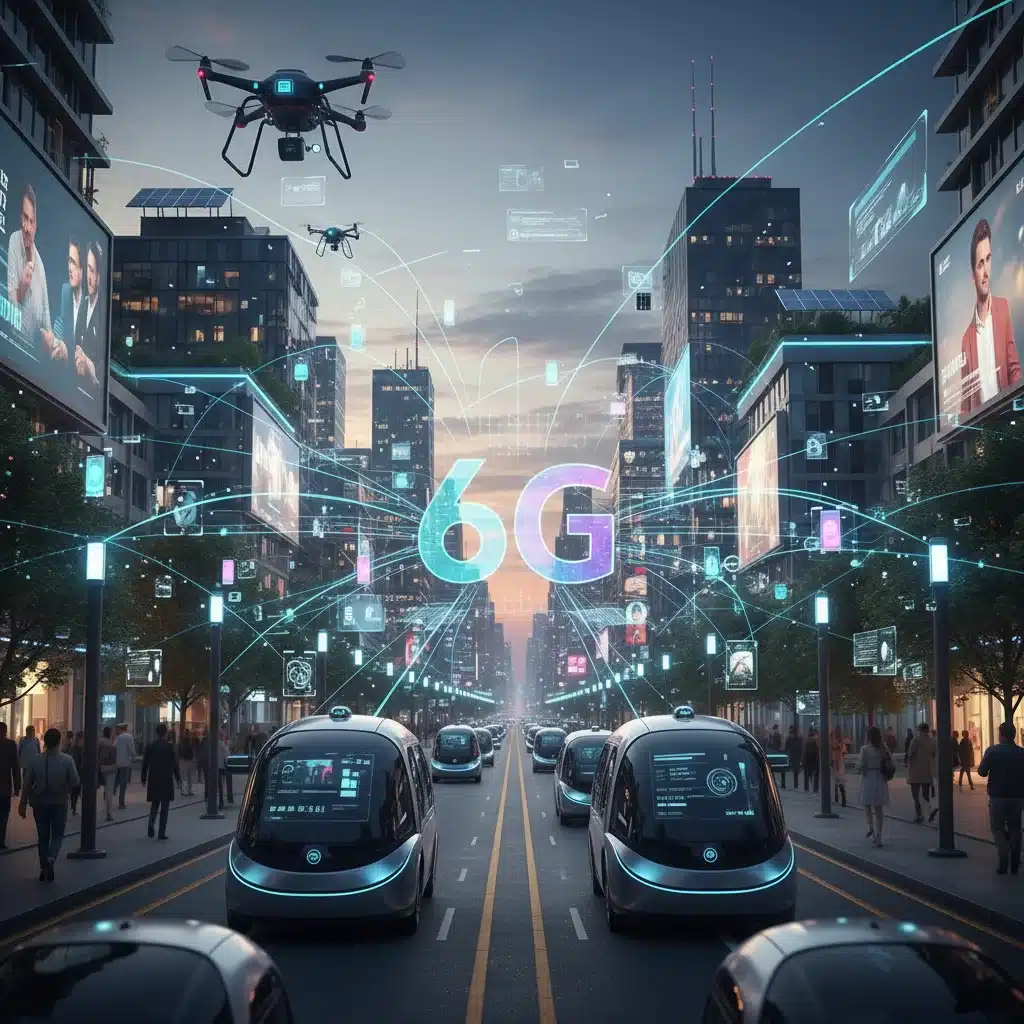
The deployment of RIS will fundamentally change how 6G US Infrastructure is designed and optimized. Instead of relying solely on more base stations, we can intelligently modify the environment. RIS panels could be integrated into building facades, lampposts, billboards, and even ceilings indoors. This creates a ‘smart’ environment that actively participates in signal propagation, leading to more ubiquitous, reliable, and energy-efficient connectivity. The cost-effectiveness and passive nature of RIS make them an attractive solution for filling coverage gaps and enhancing performance in dense urban areas and complex indoor environments, complementing the dense THz small cell deployments.
The Broader Impact of 6G on US Society and Economy
The integration of these four next-gen 6G technologies will have far-reaching consequences for the US, driving innovation across multiple sectors and reshaping the fabric of society.
Economic Growth and Innovation
- New Industries and Jobs: The development and deployment of 6G will spur the creation of entirely new industries and millions of jobs in research, manufacturing, deployment, and service provision.
- Productivity Boost: Enhanced automation, real-time data analytics, and seamless connectivity will significantly boost productivity across sectors like manufacturing, agriculture, and logistics.
- Digital Economy Expansion: The digital economy will expand exponentially, with new business models emerging around immersive experiences, AI-driven services, and hyper-connected ecosystems.
Public Services and Quality of Life
- Smart Cities and Rural Connectivity: 6G will enable truly smart cities with intelligent traffic management, public safety systems, and environmental monitoring. It will also bridge the digital divide, bringing high-speed connectivity to underserved rural areas.
- Healthcare Revolution: Remote surgery, AI-powered diagnostics, personalized medicine, and ubiquitous health monitoring will transform healthcare delivery, making it more accessible and efficient.
- Education and Training: Immersive learning environments, virtual classrooms, and real-time collaborative tools will revolutionize education and workforce training.
National Security and Resilience
- Enhanced Defense Capabilities: 6G will provide secure, ultra-reliable communication for military operations, enabling advanced reconnaissance, autonomous defense systems, and real-time situational awareness.
- Critical Infrastructure Protection: The inherent security features and AI-driven monitoring of 6G networks will bolster the resilience of critical infrastructure against cyber and physical threats.
- Disaster Response: Rapidly deployable 6G networks and integrated sensing capabilities will significantly improve disaster prediction, response, and recovery efforts.
Challenges and the Road Ahead for 6G US Infrastructure
While the promise of 6G is immense, its realization presents significant challenges that the US must address strategically.
Technical Hurdles
- Spectrum Allocation and Harmonization: Identifying and allocating sufficient THz spectrum globally and within the US will be a complex regulatory and international coordination effort.
- Energy Consumption: While RIS are energy-efficient, the sheer density of THz small cells and the computational demands of AI-native networks could lead to increased overall energy consumption if not managed carefully.
- Hardware Development: Developing cost-effective, high-performance THz components and AI accelerators at scale remains a significant engineering challenge.
Policy and Regulatory Frameworks
- Standardization: International collaboration on 6G standards is crucial to ensure interoperability and avoid fragmentation.
- Security and Privacy: Robust legal and ethical frameworks are needed to address the heightened security risks and privacy concerns associated with pervasive sensing and AI-driven networks.
- Infrastructure Investment: Significant public and private investment will be required to build out the dense, fiber-rich 6G infrastructure.
Workforce Development
A highly skilled workforce will be essential for researching, developing, deploying, and maintaining 6G networks. Investment in STEM education and specialized training programs will be critical to meet this demand.
Conclusion: The Hyper-Connected Future of the US
The journey towards 6G is a testament to humanity’s relentless pursuit of better connectivity and intelligence. By 2030, the integration of terahertz communication, AI-native networks, integrated sensing and communication, and reconfigurable intelligent surfaces will not merely upgrade our internet; it will fundamentally transform 6G US Infrastructure. This transformation will pave the way for a hyper-connected society, where digital and physical realities seamlessly merge, enabling unprecedented levels of automation, intelligence, and human-machine interaction.
The United States has a unique opportunity to lead this global revolution, securing its economic prosperity, enhancing its national capabilities, and improving the quality of life for all its citizens. Realizing this vision will require concerted effort from government, industry, and academia, fostering innovation, addressing challenges, and making strategic investments in the infrastructure of tomorrow. The future of connectivity is not just faster; it is smarter, more pervasive, and profoundly transformative, and 6G is the key to unlocking this future for the US.