2026 Cybersecurity Threats: US Business Risks & Proactive Defenses

US businesses must prepare for escalating 2026 cybersecurity threats, including sophisticated AI-driven attacks and complex supply chain vulnerabilities, by implementing robust, proactive defense strategies to protect critical assets.
The digital landscape is evolving at an unprecedented pace, and with it, the sophistication of cyber threats. For US businesses, understanding and preparing for 2026 cybersecurity threats is not merely an IT concern, but a fundamental aspect of business continuity and strategic planning. Are you ready to face the next wave of digital adversaries?
The evolving threat landscape: what’s new in 2026?
As we navigate towards 2026, the nature of cyber threats confronting US businesses continues to shift, becoming more intricate and pervasive. Traditional defense mechanisms, while still important, are proving insufficient against adversaries leveraging advanced technologies. This section explores the emerging characteristics of these threats, highlighting why a dynamic and adaptive security posture is paramount for survival.
The integration of artificial intelligence (AI) and machine learning (ML) into everyday business operations, while beneficial for efficiency, simultaneously presents new attack vectors. Attackers are now harnessing AI to craft highly personalized phishing campaigns, automate malware generation, and even bypass sophisticated detection systems. This means that distinguishing between legitimate and malicious activities becomes increasingly difficult, demanding more intelligent defensive tools.
AI-powered attacks: a new frontier for adversaries
The rise of generative AI has fundamentally altered the cyber threat landscape. Attackers are no longer limited by manual processes or basic scripting; they can now deploy AI tools to accelerate and enhance their campaigns. This includes everything from deepfake-powered social engineering to polymorphic malware that constantly changes its signature to evade detection.
- Deepfake social engineering: AI-generated audio and video used to impersonate executives or trusted individuals, tricking employees into divulging sensitive information or authorizing fraudulent transactions.
- Automated vulnerability exploitation: AI algorithms can rapidly scan for and exploit newly discovered vulnerabilities across vast networks, reducing the window of opportunity for defenders.
- Polymorphic malware: Malware that uses AI to continuously mutate its code, making it incredibly difficult for signature-based antivirus solutions to identify and neutralize.
Understanding these AI-powered tactics is the first step in developing effective countermeasures. Businesses must recognize that the enemy is no longer just human; it’s an intelligent, adaptive system capable of learning and evolving.
Furthermore, the increasing reliance on cloud infrastructure and remote work models has expanded the attack surface considerably. Data is no longer confined within a secure perimeter; it traverses numerous networks and resides in various cloud environments, each presenting potential points of compromise. Organizations must extend their security strategies beyond traditional boundaries to encompass these distributed assets.
In conclusion, the 2026 threat landscape is defined by technological sophistication and expanded attack surfaces. AI-powered attacks, coupled with the complexities of modern IT environments, necessitate a proactive and intelligent approach to cybersecurity. Businesses that fail to adapt risk significant financial and reputational damage.
Supply chain vulnerabilities: a growing systemic risk
Beyond direct attacks, US businesses in 2026 face an elevated risk from vulnerabilities embedded within their supply chains. A single compromised vendor or partner can serve as a conduit for attackers to infiltrate an entire network of organizations, leading to widespread disruption and data breaches. This systemic risk is amplified by the intricate web of third-party relationships that characterize modern commerce.
The interconnectedness of global supply chains means that a security lapse in one component, however small, can have cascading effects. Attackers are increasingly targeting smaller, less secure vendors as an entry point to larger, more lucrative targets. This makes a comprehensive understanding of third-party risk management an indispensable part of any robust cybersecurity strategy.
Evaluating third-party risk: beyond the perimeter
Assessing the security posture of every entity within your supply chain is a monumental task, yet it is absolutely critical. Many businesses focus solely on their internal defenses, overlooking the potential weak links introduced by partners. This oversight can be catastrophic, as evidenced by numerous high-profile breaches originating from third-party compromise.
- Vendor security assessments: Regular and thorough evaluations of third-party security controls, including penetration testing and vulnerability scanning, are essential.
- Contractual security clauses: Incorporate stringent cybersecurity requirements and liability clauses into all vendor contracts, ensuring partners adhere to your security standards.
- Continuous monitoring: Implement solutions to continuously monitor the security posture of critical vendors, providing real-time alerts to potential compromises.
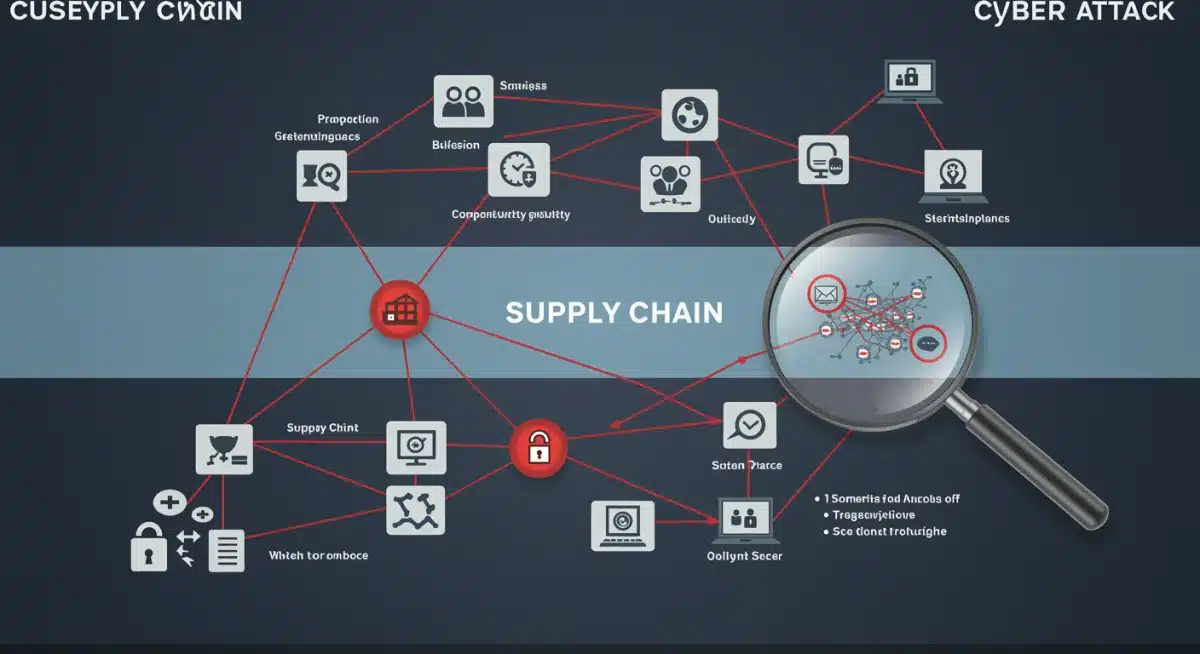
Moreover, the increasing use of open-source software and shared development platforms introduces additional, often hidden, vulnerabilities. A single malicious package or poorly maintained library can compromise countless applications and systems across the supply chain. Businesses must implement rigorous software supply chain security practices, including code integrity checks and dependency scanning.
The complexity of modern supply chains demands a shift from reactive security measures to proactive risk identification and mitigation. Businesses must adopt a holistic view of their security, recognizing that their perimeter extends far beyond their immediate network boundaries. Ignoring this extended perimeter leaves them exposed to significant and often undetectable threats.
In summary, supply chain vulnerabilities represent a critical systemic risk for US businesses in 2026. A proactive approach to evaluating and managing third-party risk, coupled with robust software supply chain security, is vital to prevent widespread compromises and maintain operational integrity.
Data privacy and regulatory compliance: a moving target
In 2026, the landscape of data privacy and regulatory compliance continues to expand and evolve, presenting US businesses with a complex set of challenges. New legislation and stricter enforcement of existing regulations mean that protecting customer and proprietary data is not just good practice, but a legal imperative. Non-compliance can result in severe financial penalties, reputational damage, and loss of customer trust.
The increasing volume and sensitivity of data collected by businesses make them prime targets for cyberattacks aimed at data exfiltration. Consequently, maintaining robust data protection measures and ensuring adherence to privacy frameworks like GDPR, CCPA, and emerging state-specific regulations is paramount. This requires a continuous effort to understand and adapt to the ever-changing legal and ethical standards surrounding data.
Navigating the regulatory maze: staying compliant in 2026
Compliance is no longer a one-time audit; it’s an ongoing process that demands constant vigilance and adaptation. Businesses must invest in legal and technical expertise to interpret complex regulations and implement the necessary safeguards. The penalties for non-compliance are steep, making it a critical area of focus for executive leadership.
- Regular legal counsel: Engage with legal experts specializing in data privacy to stay updated on new regulations and interpret their implications for your business.
- Data mapping and classification: Understand what data you collect, where it’s stored, how it’s processed, and who has access to it. Classify data by sensitivity to prioritize protection efforts.
- Privacy by design: Integrate privacy considerations into the design of all new systems, products, and services from the outset, rather than as an afterthought.
Beyond mere compliance, businesses must cultivate a culture of privacy and data stewardship. This involves regular employee training, clear data handling policies, and transparent communication with customers about how their data is used and protected. Trust is a valuable currency in the digital age, and a strong commitment to privacy builds that trust.
The push for data localization, where certain types of data must be stored and processed within specific geographic boundaries, adds another layer of complexity. For businesses operating internationally, this necessitates a careful review of their data architecture and potentially the establishment of local data centers or cloud instances. This impacts both operational costs and technical infrastructure.
In conclusion, navigating the evolving landscape of data privacy and regulatory compliance in 2026 is a significant challenge for US businesses. A proactive approach that combines legal expertise, robust data protection measures, and a commitment to privacy by design is essential to avoid penalties and maintain customer trust.
Proactive defense measure 1: advanced threat intelligence and automation
To effectively combat the sophisticated 2026 cybersecurity threats, US businesses must move beyond reactive security models and embrace proactive defense strategies. The first critical measure involves leveraging advanced threat intelligence coupled with intelligent automation. This approach allows organizations to anticipate attacks, understand adversary tactics, and automate responses, significantly reducing reaction times and mitigating potential damage.
Threat intelligence involves collecting and analyzing information about current and emerging cyber threats, including attacker methodologies, tools, and indicators of compromise (IoCs). When this intelligence is fed into automated security systems, it creates a powerful defense mechanism that can detect and neutralize threats before they can cause significant harm. This shift from manual to automated processes is vital in an era where attack speeds are measured in milliseconds.
Implementing intelligent automation for rapid response
The sheer volume of security alerts and potential threats makes manual analysis and response impractical. Intelligent automation, powered by AI and machine learning, can sift through vast amounts of data, identify patterns, and execute predefined responses without human intervention. This not only speeds up incident response but also frees up human analysts to focus on more complex, strategic threats.
- Security Orchestration, Automation, and Response (SOAR): Deploy SOAR platforms to integrate security tools, automate workflows, and orchestrate incident response playbooks, ensuring consistent and rapid reactions to threats.
- AI-driven anomaly detection: Utilize AI to establish baselines of normal network and user behavior, then flag any deviations as potential threats, identifying novel attacks that signature-based systems might miss.
- Automated patch management: Implement systems that automatically identify critical vulnerabilities and apply patches across endpoints and servers, closing common attack vectors before they can be exploited.
Integrating threat intelligence feeds directly into security information and event management (SIEM) systems and endpoint detection and response (EDR) solutions is crucial. This ensures that the latest threat data is immediately actionable, allowing security tools to update their detection rules and proactively block known malicious activity. The goal is to create a self-healing and self-defending network that continuously adapts to new threats.
Moreover, proactive threat hunting, informed by advanced intelligence, allows security teams to actively search for hidden threats within their networks, rather than waiting for alerts. This involves using intelligence about adversary techniques to hypothesize potential compromises and then using forensic tools to confirm or deny their presence. This approach helps uncover advanced persistent threats (APTs) that might have bypassed initial defenses.
In conclusion, advanced threat intelligence and automation are indispensable for US businesses confronting 2026 cybersecurity threats. By understanding the adversary and automating defensive actions, organizations can achieve a more resilient and responsive security posture, minimizing the impact of increasingly sophisticated cyberattacks.
Proactive defense measure 2: zero trust architecture adoption
The second essential proactive defense measure for US businesses in 2026 is the widespread adoption of a Zero Trust architecture. Moving away from the outdated perimeter-centric security model, Zero Trust operates on the principle of ‘never trust, always verify.’ This means that no user, device, or application is inherently trusted, regardless of whether they are inside or outside the traditional network boundary. Every access attempt must be authenticated and authorized.
This architectural shift is particularly relevant given the rise of remote work, cloud computing, and complex supply chains, which have rendered traditional network perimeters largely obsolete. A Zero Trust model significantly reduces the risk of insider threats and lateral movement by attackers who might gain initial access to a network. It enhances security by enforcing granular access controls and continuous verification.
Implementing a ‘never trust, always verify’ approach
Transitioning to Zero Trust involves a fundamental rethinking of how access is granted and managed across an organization’s IT ecosystem. It’s not a single product but a strategic approach that integrates various security technologies and principles. The core tenets involve micro-segmentation, multi-factor authentication (MFA), and strict access policies based on context.
- Micro-segmentation: Divide the network into small, isolated segments, limiting lateral movement for attackers even if they breach one segment. This contains threats and prevents widespread compromise.
- Multi-factor authentication (MFA): Require multiple forms of verification for all users accessing resources, significantly reducing the risk of credential theft and unauthorized access.
- Least privilege access: Grant users and devices only the minimum necessary permissions to perform their tasks, minimizing the potential impact of a compromised account.
Continuous monitoring and verification are also pillars of a Zero Trust strategy. Access is not a one-time grant; it’s continuously evaluated based on factors like user behavior, device health, location, and the sensitivity of the resource being accessed. Any deviation from expected behavior can trigger re-authentication or restrict access, providing dynamic security.
Furthermore, strong identity and access management (IAM) solutions are foundational to Zero Trust. These systems manage user identities, authenticate access requests, and enforce policies across all applications and data. Integrating IAM with endpoint security and network controls creates a cohesive and robust security framework.
In conclusion, adopting a Zero Trust architecture is a powerful proactive defense against the complex 2026 cybersecurity threats. By implementing a ‘never trust, always verify’ philosophy, US businesses can significantly enhance their security posture, protect critical assets, and build resilience against both external and internal threats.
Proactive defense measure 3: robust security awareness and training
The third crucial proactive defense measure for US businesses navigating 2026 cybersecurity threats is the implementation of robust and continuous security awareness and training programs. While technology forms the backbone of cybersecurity, human error remains a leading cause of breaches. A well-informed and vigilant workforce acts as a critical line of defense, capable of identifying and reporting suspicious activities before they escalate.
Cybercriminals frequently target employees through social engineering tactics like phishing, pretexting, and baiting, exploiting human psychology rather than technical vulnerabilities. Therefore, empowering employees with the knowledge and skills to recognize and resist these attacks is as vital as any firewall or intrusion detection system. Security awareness should not be a one-off event but an ongoing educational process.
Cultivating a human firewall: empowering employees
Effective security awareness training goes beyond basic password hygiene. It delves into the nuances of modern cyber threats, educating employees about the latest attack vectors and their potential impact. The goal is to foster a security-conscious culture where every employee understands their role in protecting the organization’s assets.
- Simulated phishing campaigns: Regularly conduct realistic phishing simulations to test employee vigilance and provide immediate, targeted training to those who fall for the lures.
- Interactive training modules: Use engaging and scenario-based training that addresses specific threats relevant to different departments, making the learning experience more impactful and memorable.
- Reporting mechanisms: Establish clear and easy-to-use channels for employees to report suspicious emails, links, or activities without fear of reprimand, encouraging a proactive reporting culture.
The training content should be regularly updated to reflect the evolving threat landscape, including new AI-powered social engineering techniques. It should also cover best practices for secure remote work, safe use of personal devices, and the importance of data privacy in daily operations. Making security relevant to employees’ daily tasks increases engagement and retention of knowledge.
Furthermore, executive buy-in and participation are essential for the success of any security awareness program. When leadership actively champions cybersecurity, it signals to the entire organization that security is a top priority, fostering a culture of collective responsibility. Regular communication about recent threats and successful defenses can also reinforce the importance of vigilance.
In conclusion, robust security awareness and training programs are indispensable for US businesses facing 2026 cybersecurity threats. By effectively educating and empowering employees, organizations can build a resilient human firewall, significantly reducing the risk of breaches caused by human error and enhancing their overall security posture.
| Key Threat/Measure | Brief Description |
|---|---|
| AI-Powered Attacks | Sophisticated attacks leveraging AI for deepfakes, automated exploitation, and polymorphic malware. |
| Supply Chain Vulnerabilities | Risks from compromised third-party vendors and open-source software within the business ecosystem. |
| Advanced Threat Intelligence | Utilizing data on evolving threats with automation for rapid detection and response. |
| Zero Trust Architecture | ‘Never trust, always verify’ approach with micro-segmentation and continuous authentication. |
Frequently asked questions about 2026 cybersecurity
In 2026, US businesses face heightened risks from AI-powered attacks, including sophisticated deepfakes and polymorphic malware. Additionally, vulnerabilities within complex supply chains and increasingly stringent data privacy regulations pose significant challenges. These threats demand more advanced and adaptive defensive strategies.
Mitigating AI-powered attacks requires a multi-faceted approach. This includes deploying AI-driven anomaly detection systems, implementing advanced threat intelligence, and continually updating security awareness training to educate employees about deepfake social engineering. Automated patch management also helps close common entry points.
Zero Trust architecture is crucial because it eliminates implicit trust, verifying every user and device regardless of location. This model, with micro-segmentation and continuous authentication, significantly reduces the impact of breaches by preventing lateral movement and containing threats within isolated network segments.
Employee training is paramount in 2026 cybersecurity. Human error remains a primary attack vector, making robust security awareness programs essential. Training helps employees recognize sophisticated social engineering tactics and fosters a security-conscious culture, turning the workforce into a critical line of defense against cyber threats.
Addressing supply chain risks involves thorough vendor security assessments, incorporating stringent security clauses in contracts, and continuous monitoring of third-party security postures. Implementing robust software supply chain security practices, including code integrity checks, is also vital to protect against systemic vulnerabilities.
Conclusion
The landscape of 2026 cybersecurity threats demands a proactive and adaptive stance from US businesses. The confluence of advanced AI-powered attacks, escalating supply chain vulnerabilities, and evolving regulatory pressures creates a complex environment where traditional security measures are no longer sufficient. By embracing comprehensive threat intelligence and automation, adopting a Zero Trust architecture, and fostering a culture of robust security awareness through continuous training, organizations can build resilient defenses. The time to act is now, transforming cybersecurity from a reactive necessity into a strategic advantage that safeguards operations, protects data, and maintains trust in an increasingly digital world.